
The JNBridge R&D Showcase demonstrates what’s possible via cutting-edge scenarios or “labs” that bridge Java and .NET. These are free kits which include full documentation and source code that allow you to explore, experiment, and expand.
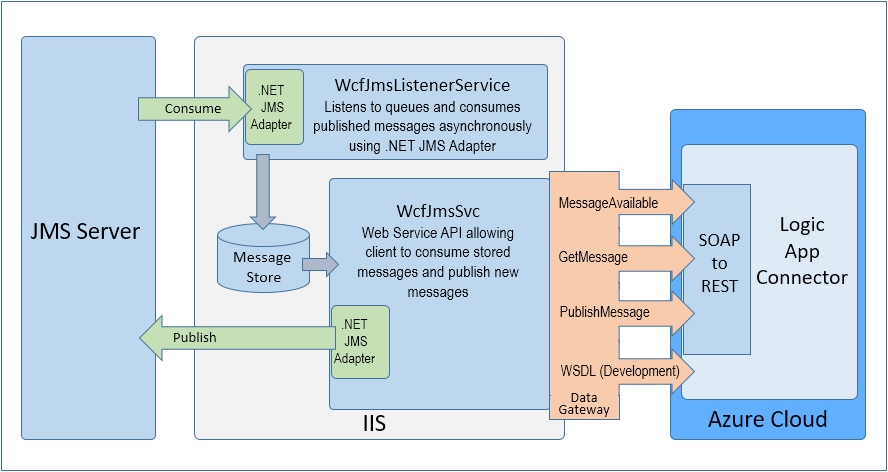
Azure Logic Apps Connector for JMS
Create a Custom Azure Logic App Connector using the JNBridge JMS Adapter for .NET
Microsoft’s Azure Logic Apps is a cloud service that allows users to create business processes and workflows that can run in the cloud, on premises, or both. Like other orchestrations, Azure Logic Apps take data from one source and conditionally redirect the data to one or more destinations.
Azure Logic Apps uses connectors to hook the Logic Apps into existing infrastructures. While Microsoft maintains a library of connectors, anything not on this list must be built as a custom connector: a time-consuming and not well-understood process. In particular, no connector exists to connect Logic Apps to JMS message brokers. As JMS is the standard mechanism for directing messages around enterprise IT infrastructures, JNBridge views this as a major shortcoming.
This kit shows how to implement an Azure Logic Apps Connector for JMS, allowing you to use the Azure Logic Apps infrastructure to send and receive messages from existing JMS (Java Message Service) infrastructures. The connector uses the JNBridge JMS Adapter for .NET. Like the Adapter, the connector will work with any vendor’s JMS implementation, and even allows you to switch vendors without having to rebuild the connector.
Integrating Java- and Mono-based Microservices Using Docker
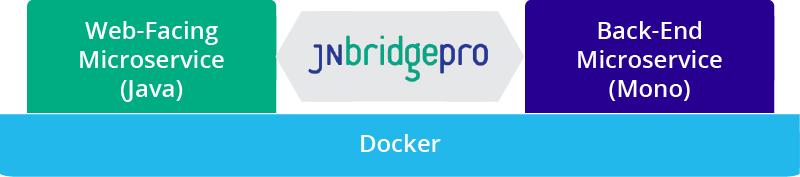
This JNBridge Lab demonstrates how to deploy both Java and .NET sides of a JNBridgePro-enabled application as a Docker container.
Container technology, and Docker in particular, is a substantial advance in the deployment of enterprise software. In particular, containers finally make microservices practical, due to the fact that containers are much less resource intensive than full-fledged virtual machines. For applications that use JNBridgePro, their .NET and Java sides in many instances can be thought of as microservices, communicating via the JNBridgePro TCP/binary or HTTP/SOAP channels. This lab takes an application that uses JNBridgePro and show how the .NET and Java side can each be deployed as a Docker container, and how they can be set up to interact with each other and with the outside world.
Using the Play Framework to Create a Java Web Application on Top of a .NET Back-End
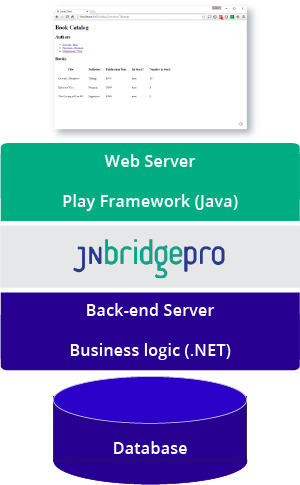
This JNBridge Lab demonstrates how to create a Java web application that relies on a .NET-based back-end. We’ll use the Play Framework to build the front-end presentation layer, and .NET to implement the back-end business logic and data layer.
The Play Framework is based on Java and Scala, so JNBridgePro is an ideal tool for connecting Play web applications to .NET-based business logic. The example is based on the Books Demo, implementing a simple inventory system for a bookstore, which is distributed with the JNBridgePro installation. In the original Books Demo, the front end was implemented in ASP.NET, and the back end was Java. Here, we will invert this, so that the front end is written in Java using the Play Framework, and the back end is in .NET.
Create a .NET-based Visual Monitoring System for Hadoop
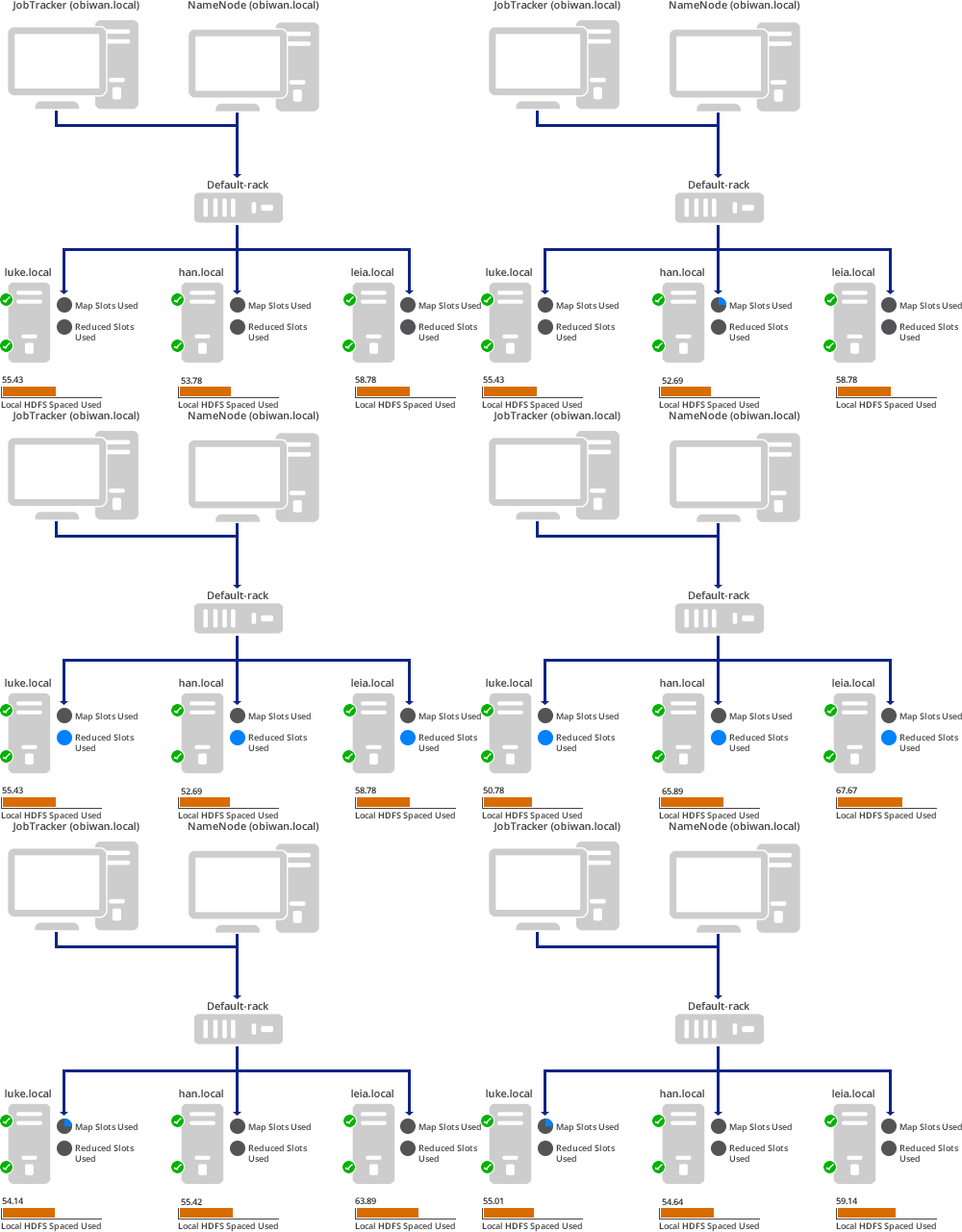
Visually monitor the status of all the nodes in a Hadoop cluster in real time. Designed to work with any implementation of Hadoop, the Lab shows you how to integrate an existing visualization tool, such as Visio, in order to leverage the superior graphical capabilities available in a .NET framework. The lab also shows you how to push or pull any information in or out of Hadoop that its APIs permit.
Building a LINQ provider for HBase MapReduce
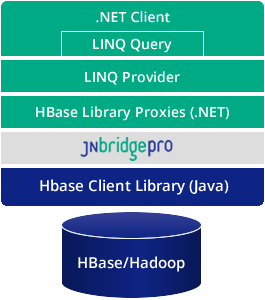
Explore building a simple .NET LINQ provider for HBase. This lab uses the Java API for creating, managing and scanning HBase tables and the .NET LINQ provider interfaces. In addition, the project investigates LINQ support for HBase MapReduce jobs written in Java by adding an extension to the LINQ query syntax.
Build an Excel Add-in for HBase MapReduce
Create a simple Excel front-end to HBase MapReduce. The front-end will allow you to view HBase tables and execute MapReduce jobs. The goal is to make the add-in generic with respect to the column definitions and data in an HBase table.

Creating .NET-based MapReducers for Hadoop
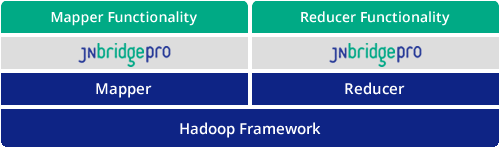
Write. NET-based Hadoop MapReducers directly against the Java-based Hadoop API — without having to use Hadoop streaming or incurring the overhead costs of parsing the stream.
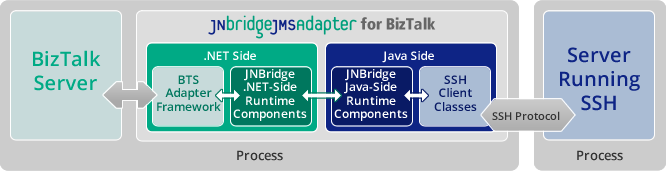
Using a Java SSH Library to Build a BizTalk Adapter
Use Java Secure Shell (SSH) to enable BizTalk Server to manipulate remote files securely, in the cloud or on the ground. This Lab provides straightforward instructions to create a BizTalk adapter using JNBridePro and the BizTalk Adapter Framework SDK. Such an adapter can be used to allow BizTalk Server to read and write files security to and from the cloud, and to communicate easily with Unix/Linux machines.