
Connect anything Java any JVM JMS, EJB JNDI, JSP AWT, SWT, Swing Jakarta EE Hadoop, Kafka, HDFS JAR files any Java app server Groovy, Clojure, Jython
with anything .NET .NET Core .NET Framework C# library DLL file WPF or WinForms ASP.NET F#, C#, IronPython LINQ
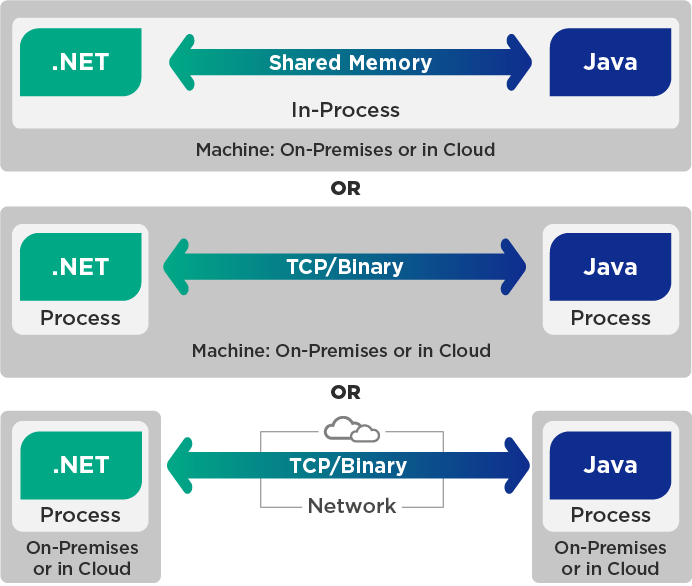
anywhere in the same process in different processes across a network on premises in the Cloud (Azure, AWS...) on Windows or Linux

Get your Java and .NET based (C#, VB) components working together, quickly and easily.

Full Access
Gain full access to any Java or .NET API on the other side, whether it’s services-enabled or not. Expose any Java or .NET binary, no source code required!

Fast Time to Market
Solve your Java & .NET cross-platform interoperability issues quickly and easily, so you can focus on what matters.

High Performance
JNBridgePro is 100′s-1000′s times faster than web services. It’s perfect for when performance matters.

Make the Complicated Simple
JNBridgePro makes the incompatible compatible, so you don’t have to. Calls to Java code from .NET or calls to .NET code from Java will look just like native, local code.
Access Best-of-Breed Components
You don’t need to sacrifice using the best components for any job just because they were written for the other platform.

Save Money
Reduce your up-front development costs. Preserve your exsiting investments. Save long-term maintenance costs by keeping the original Java or .NET source code untouched.
Really Anything?
Anything includes:
| Java Side | .NET Side | |
| UIs | AWT, SWT, Swing | WPF, WinForms, ASP .NET |
| APIs and Services | JMS, EJB, JMX, JNDI, JSP | WCF, MSMQ |
| Custom Objects | Custom Java objects, Classes, Instance Members, Static Members, Fields, Properties Methods, Generics, Enums, Events, Transactions | Custom .NET objects, Classes, Instance Members, Static Members, Fields, Properties Methods, Generics, Enums, Events, Transactions |
| Base Class Library | Java base class library | .NET base class library |
| App Servers and Integration Servers | WebLogic, WebSphere, WildFly (JBoss), Active MQ, Glassfish | BizTalk, Neuron ESB |
| Big Data | Hadoop, Kafka, HBase, HDFS | |
| Language | Java, Groovy, Clojure, Jython | C#, F#, IronPython, C++, VB.NET… |
| Runtime | JVM | .NET Framework, .NET Core, Mono |
| OS | Any supported JVM | Windows, Linux |
Deploy Anywhere
- In the same process
- In separate processes on the same machine
- Across any network
- On a real machine or in a virtual machine or container
- On the ground or in the cloud
- Your Java side can run in any standard JVM, on any platform.
- Your .NET side can run on Windows (.NET Framework, .NET Core, or Mono) or on Linux (.NET Core or Mono).
- Reconfigure your deployment architecture on the fly with a simple configuration file change.