


Business Challenge
Achieve durable messaging between a broad spectrum of .NET applications and JMS while enabling an SOA infrastructure to support multiple relocation service portals.
Solution
The JNBridge JMS Adapter for .NET allowed Graebel to leverage existing business logic and easily integrate JMS messaging with their .NET-based SOA framework.
“We liked the fact that the adapter had a WCF binding that plugged right into our .NET applications. With our extensive set of application portals, there are at least 15 possible endpoints for message routing, including internal and external portals based on Sharepoint Server and ASP.NET.”
Don Tarkenton, Chief Information Officer, Graebel Companies, Inc.
About Graebel
Founded in 1950, Graebel provides worldwide relocation and moving services, freight forwarding, move management and commercial office moving and workplace services. Employing an extensively background-checked and trained workforce, Graebel is a wholly owned, privately-held company that boasts innovative technology and processes.
About JNBridge
JNBridge connects Java and .NET components and applications together via easy- to-use tools and adapters, solving complex issues of cross-platform interoperability. JNBridge provides fast access to anything Java from anything .NET, and anything .NET from anything Java, including JMS, EJBs, J2SE, J2EE, .NET APIs, WinForms, or BizTalk Server. JNBridge has over 350 unique customers in 40 countries that use JNBridge solutions in a wide variety of applications, including financial services, insurance, media, healthcare and manufacturing.

3024 Jefferson St.
Boulder, CO 80304
Tel: (+1) 303.545.9371
JMS Adapter for .NET Simplifies Transition to SOA Framework for Relocation Services
Situation
Graebel Companies, Inc. performs comprehensive global relocation and moving services for a wide variety of corporate clients. Divisions include Graebel Relocation Services Worldwide, Inc., Graebel Movers International, Inc., Graebel Commercial Services, Inc., Graebel Van Lines, Inc., Graebel Movers, Inc., and Move Management, Inc. In addition to these core business divisions, the company relies on close alliances with regional destination service providers to deliver an extensive portfolio of on-the-ground relocation services worldwide.
Since its founding in 1950, Graebel has grown dramatically from a local mover into an international full-service relocation organization. As the company expanded, Graebel became increasingly adept at managing not only its customers’ logistics, but also the IT systems and applications that support its business. Early on, an implementation of Oracle® Financials gave rise to a variety of independent Oracle database applications. In the last six years, the centralized IT organization has focused on evolving and simplifying the underlying application infrastructure.
Challenge
“We run quite a landscape of applications,” said Don Tarkenton, Chief Information Officer of Graebel Companies, Inc. “We needed a standard way to integrate them, which started our move to an SOA infrastructure.” The developers at Graebel implemented an SOA framework using .NET to integrate data across divisions and build information portals targeted at specific customer types. The SOA infrastructure allows Graebel to deliver relocation services quickly and cost-effectively to various “arms-length” customers, such as corporate transferees and their family members, corporate decision-makers, and third-party service providers. Using a rapid prototyping strategy and short life-cycles, developers can rapidly create and adapt portals that meet the needs of Graebel’s broad client base.
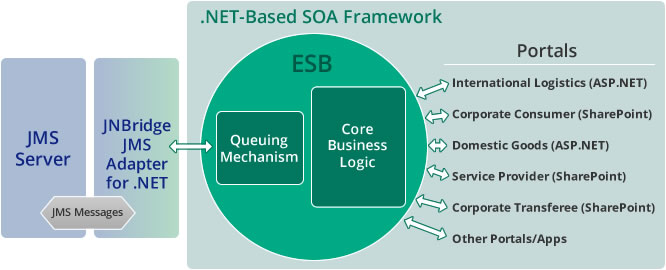
At the backbone of the SOA framework, the Enterprise Service Bus (ESB) is a standards-based infrastructure for building composite applications that integrate with legacy back-end data and services. The ESB includes a queuing mechanism that routes messages between service endpoints. Using Microsoft .NET WCF (Windows Communication Foundation) APIs, Graebel wanted to achieve durable messaging between .NET services and a Java Message Service infrastructure (specifically Apache ActiveMQ and Oracle Advanced Queuing). “The JNBridge JMS Adapter for .NET was critical to our successful SOA implementation,” added Tarkenton, “because it natively supports .NET WCF.” The JNBridge adapter simplified the complex task of JMS and .NET interoperability, which made it easier for Graebel to simplify the applications infrastructure.
Solution
In researching interoperability solutions through SOA forums, Graebel developers learned about the JNBridge JMS Adapter for .NET. The adapter aligned perfectly with their requirements because it provides seamless integration between a JMS infrastructure and any .NET application that can consume a WCF endpoint. “We liked the fact that the adapter had a WCF binding that plugged right into our .NET applications,” said Tarkenton. “With our extensive set of portal applications, there are about 15 possible endpoints for message routing, including internal and external portals based on Sharepoint Server and ASP.NET.” As Graebel continues to build out applications, the JNBridge JMS Adapter for .NET is positioned to deliver critical integration capabilities that can help to shorten the development cycle.
Benefits
Graebel found specific advantages in using the JNBridge JMS Adapter for .NET:
- Native binding to WCF. Graebel developers found that the adapter was easily configurable through WCF services. After downloading a free evaluation copy from the JNBridge Web site (www.jnbridge.com), developers were able to get the adapter up and running quickly with their applications.
- Support for durable messaging. Using the adapter, Graebel was able to ensure message delivery between .NET applications and a JMS.
- Commercial product backed by knowledgeable and responsive support. JNBridge’s technical support helped Graebel resolve problems quickly — an important benefit over internally developed code or an open source alternative that they rejected as too difficult to implement. “Instead of spending weeks troubleshooting, JNBridge engineers resolved problems for us — in most cases within a single day,” added Tarkenton.
As a result of using the adapter, Graebel was able to trim time to market, deploying the adapter with production applications in just under two months.
Get Started
To streamline JMS and .NET integration in your business applications, download a free evaluation copy of the JNBridge JMS Adapter for .NET from www.jnbridge.com.